Sample property A
6 minWithin budget
Technical Product Director · 15 years in product & engineering
My work includes AI video production, property requirements and research agents, alongside wallets, ledgers and risk monitoring. I define product scope, coordinate delivery and help implement the critical parts.
Choose an aspect of how I work.
A creator needs to replace a weak shot. A broker needs to clarify an ambiguous request. These tasks determine what I give the model and what a person must confirm.
Replace a shot, tighten a property requirement or change an agent’s request. Watch the result change.
Two generations can change the subject’s shape. Compare the takes, then put your choice back into the timeline. The other shots stay in place.
I made the shot the unit of revision so creators can keep the parts they have already selected.
See the design behind it
 AB
Selected: take A. Play to inspect motion.
Actual AI-generated test clips. The timeline below is an interactive illustration.
Drag to compare A / B, or play the selected take. Then try replacing shot 03.
A ten-minute walk might make a property a fallback option or rule it out. The difference is whether the customer means a preference or a firm requirement.
I ask the broker to confirm that distinction before filtering. Properties with missing walking-time data stay marked for verification.
See the design behind it6 minWithin budget
10 minWithin budget
Walking time missingWithin budget
Change the walking time or make it a hard requirement. Properties with missing data still need verification.
Reading evidence, merging research changes and moving funds require different permissions. Select an action to see how the system handles it.
I tie permission to the action. Approval of research does not grant access to financial execution.
See the design behind itThese browser demos use sample data. They do not call models or business services.
Each case describes a specific task and the choices behind its design. Start with a problem relevant to your team.
AI video production
Replace a weak shot. Keep the takes you have chosen.
A production workspace for script breakdown, take selection, voice, captions and rendering. Each shot keeps its references and versions so creators can compare and revise it.
Actual AI-generated test frames
The kite has a diamond-shaped silhouette. Play the clip in the demo to inspect its movement.
The second take gives the kite a curved shape and a different position in the frame.
After generating a clip, creators still need to select takes, revise dialogue and connect the shots. A wrong movement or character appearance calls for a targeted revision while preserving the chosen material.
Creators compare generated takes within each shot, select a version and continue with voice and editing. The system tracks affected assets and marks an earlier render when it needs review.
Characters, settings and motion can drift between adjacent shots. Each frame may work on its own while the sequence fails as a story.
I bound character and location references to individual shots, kept multiple takes and made selection explicit. Rework reopens one shot, then revalidates any reused asset before it returns to the timeline.
A provider may have accepted a job even when the request times out. Retrying immediately can duplicate cost and produce two competing results for one shot.
I keep the original job ID and check whether the provider accepted it. An uncertain outcome pauses new submissions. The permitted shots and quoted cost are confirmed before sending.
A change to dialogue, captions or shot duration can silently invalidate voice, mix and timeline decisions downstream.
I versioned scripts, captions, audio and finishing separately. A material edit explicitly expires the old cut and sends the new one back through timeline review and screening.
If you are building AI content tools, I can help design take selection, versioning, revisions and review after generation.
AI workspace for property brokers
Confirm what the client wants before explaining the shortlist.
Designed for Chinese- and Japanese-speaking property brokers. AI structures the client’s request; the broker confirms it, reviews documents and compares candidates within one case.
Real interface captures · sample data
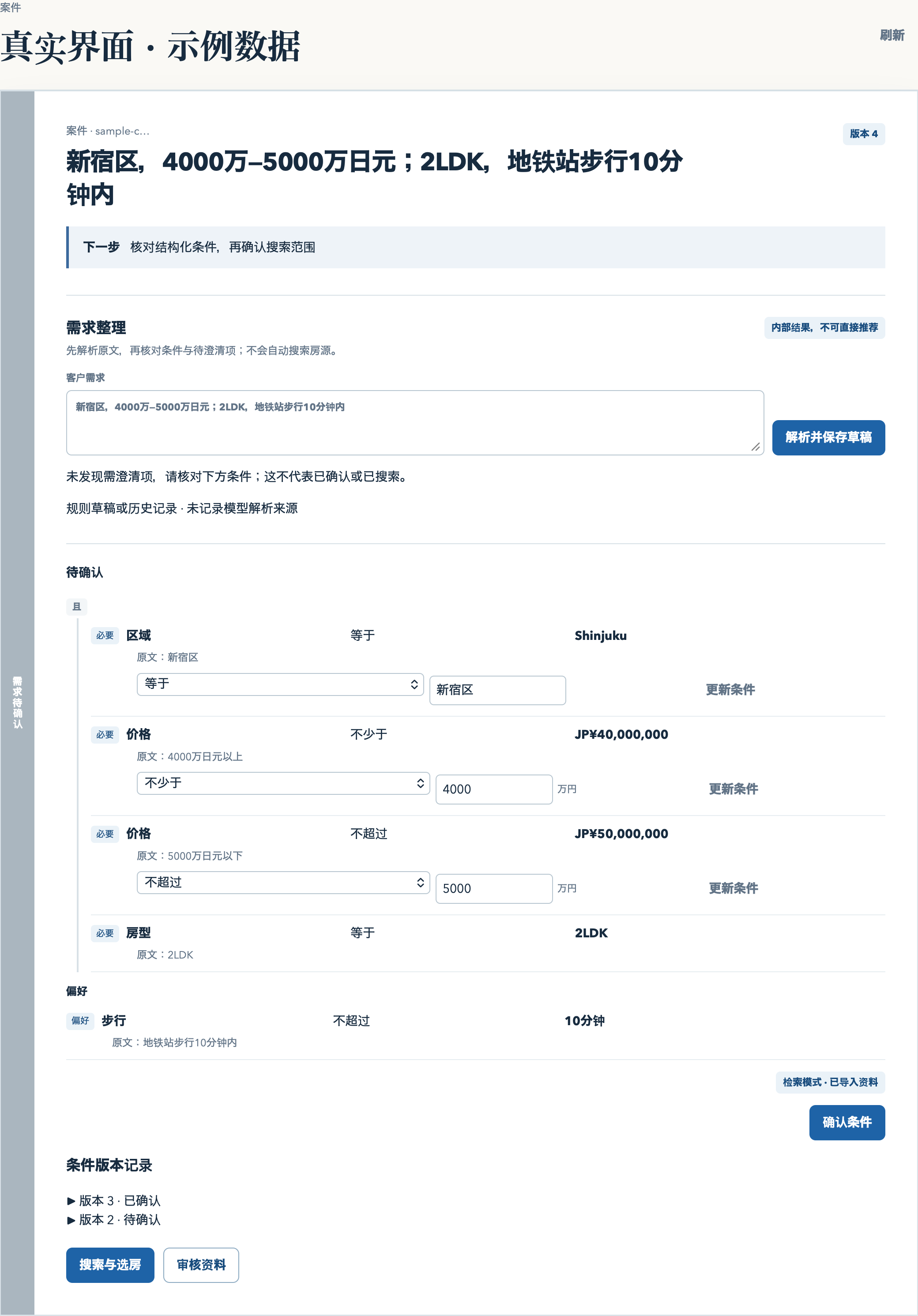
The broker can compare each condition with the original request before confirming it.
Budget, location, walking distance and lifestyle preferences often arrive in one sentence, followed by documents that conflict or expire. If ambiguity enters the search, every later shortlist becomes harder to explain.
Someone taking over a case can see the client’s words, confirmed criteria and edit history. The broker can trace a recommendation to its documents and explain both the match and any remaining checks.
‘Near the station but quiet’ mixes hard constraints, preferences and an unresolved trade-off. One bad interpretation sends the search and comparison down the wrong path.
I represent “all of these”, “any of these” and exclusions separately, keeping the client’s words beside each condition. Ambiguities require clarification before confirmation; edits remain in the version history.
Late approval, a broken session or partial coverage can look like an empty result. Reporting that as ‘no properties found’ misleads the client and can trigger an unsafe replay.
I modelled queue state, covered range, pending review, failure and unknown outcome separately. An uncertain task keeps its identity, shows what was actually observed and waits for a human decision.
A property’s identity, current price, validity and document pages may disagree. A polished summary cannot carry professional responsibility for those facts.
I grouped documents by content fingerprint and separated identity, status, price, date and rights into review fields. Only two to four reviewed candidates can enter comparison and proposal, with expiry and revocation built into sharing.
For teams making recommendations from large document sets, I can help with requirement confirmation, evidence review and explainable comparisons.
Multi-agent research operations
See each agent’s progress and the evidence for its next step.
Address analysis, screening and simulated portfolios form a research workflow. One supervision view brings together tasks, reports, data updates and actions awaiting approval. Financial actions remain proposals.
With several agents working on research, the lead needs to check whether completion has supporting evidence, whether data is stale and whether work has run twice. A backtest score cannot answer those questions.
When reviewing a task, the lead sees its report, data timestamps, permitted actions and outstanding checks together, then decides whether to continue, request changes or approve it.
Waking an agent when state has not changed produces conflicting reports. The file is newer, but the research evidence may be identical.
I used request identity, content hash and allowed state to decide whether work should run. Every queue item carries an owner, evidence, forbidden actions and a definition of done.
A strong result in one window can hide stale data, thin samples, drawdown and repeated-trial bias. Rankings can close the argument before the research is ready.
I display 7-, 30- and 90-day address profiles alongside data timestamps, simulation health, drawdown and overfitting checks. The lead can see the limits of a strong score.
Producing a report does not grant an agent authority to change strategy configuration, activate capital or own the consequence.
I separate automatic actions, actions requiring approval and financial proposals. If a supervision query lacks permission or skips a source, the interface reports an incomplete check.
For teams assigning research or development to multiple agents, I can help define ownership, evidence requirements, duplicate-work controls and human approval.
Chat-based merchant operations
Record an entry in chat. Find it in the statement.
Operators record receipts, payouts, exchange rates, fees and notes in chat, and the online statement is rebuilt from those records. Quotes, address monitoring, broadcasts and branded bots share the same operating surface.
Receipt confirmation, payouts and handovers happen in a business chat. Re-entering them in a separate form creates room for omissions. Recording directly from messages requires clear rules for actors, reply targets, corrections and reversals.
Operators record entries in chat. Owners review the online statement by date, operator and note, inspect grouped settlement and export it. Quotes and address monitoring are available through the same bot.
A misidentified reply target, duplicate delivery or inconsistent negative correction can split the chat record from the final balance.
I resolved operator, reply target, exchange rate, fee and note into explicit fields. Corrections and reversals remain in ledger history, and balances are rebuilt from active records.
Quotes expire, confirmation buttons get clicked twice and on-chain fulfilment may remain unknown. Collapsing charge, order and chain result into one ‘complete’ state creates disputes.
I put the product, address, cost and expiry on the confirmation card. Repeating the same confirmation does not create another charge. Order progress and on-chain delivery are shown separately so operators can locate a delay.
A broadcast, monitoring spike or noisy branded bot can consume another tenant’s capacity or route a notification to the wrong business group.
I bound tenant, bot and authorised group separately and rate-limited each bot independently. Monitoring shows actual coverage and gaps, and unknown values stay unknown.
If your business runs in group chats, I can help turn messages into permissioned operations with statements and traceable records, reducing the need for a separate spreadsheet.
AI seat management
Make seat ownership, access and revocation explicit.
Suppliers manage accounts, administrators review and assign them, and customers use their own platform keys. During unbinding or withdrawal, administrators can see the waiting instance count and track progress.
A shared platform needs to establish who owns an account, which customer can use it and whether requests remain active after access is withdrawn. A spreadsheet cannot reliably enforce those relationships during a request.
Customers manage their access keys and quotas. Suppliers can pause or withdraw accounts, and administrators can inspect assignment and shutdown progress. Customers do not need the upstream account’s login credentials.
If a submitted account can specify its own owner, a user could attach it to someone else. Later review and assignment would inherit that incorrect ownership.
I derive account ownership from the authenticated user and restrict actions separately for suppliers, administrators and customers. Customers receive only their platform access keys.
When an assigned seat fails, pulling any available replacement from a global pool can mix customer permissions, billing and data boundaries.
I keep a dedicated group for each customer and select fallback accounts only within that group. Each request rechecks that authorization, credentials and the assignment are still valid.
Immediate unbinding can sever in-flight requests, while replaying an unknown outcome may execute it twice. Deleting a row explains neither consequence.
Pausing blocks new requests. Unbinding and withdrawal then wait for active instances to drain. The interface shows progress. If a credential refresh has an uncertain outcome, the account is isolated and automatic retries stop.
For teams providing AI seats to multiple customers, I can help design account ownership, customer isolation, fallback assignment and withdrawal.
Multi-chain mobile wallet
One wallet, with the network and cost clear before each transfer.
Nine mainnets share one mobile asset view. A send checks chain, address, amount, fee and authentication in order. DApp requests reveal origin and signing parameters before approval.
Real interface captures · sample data
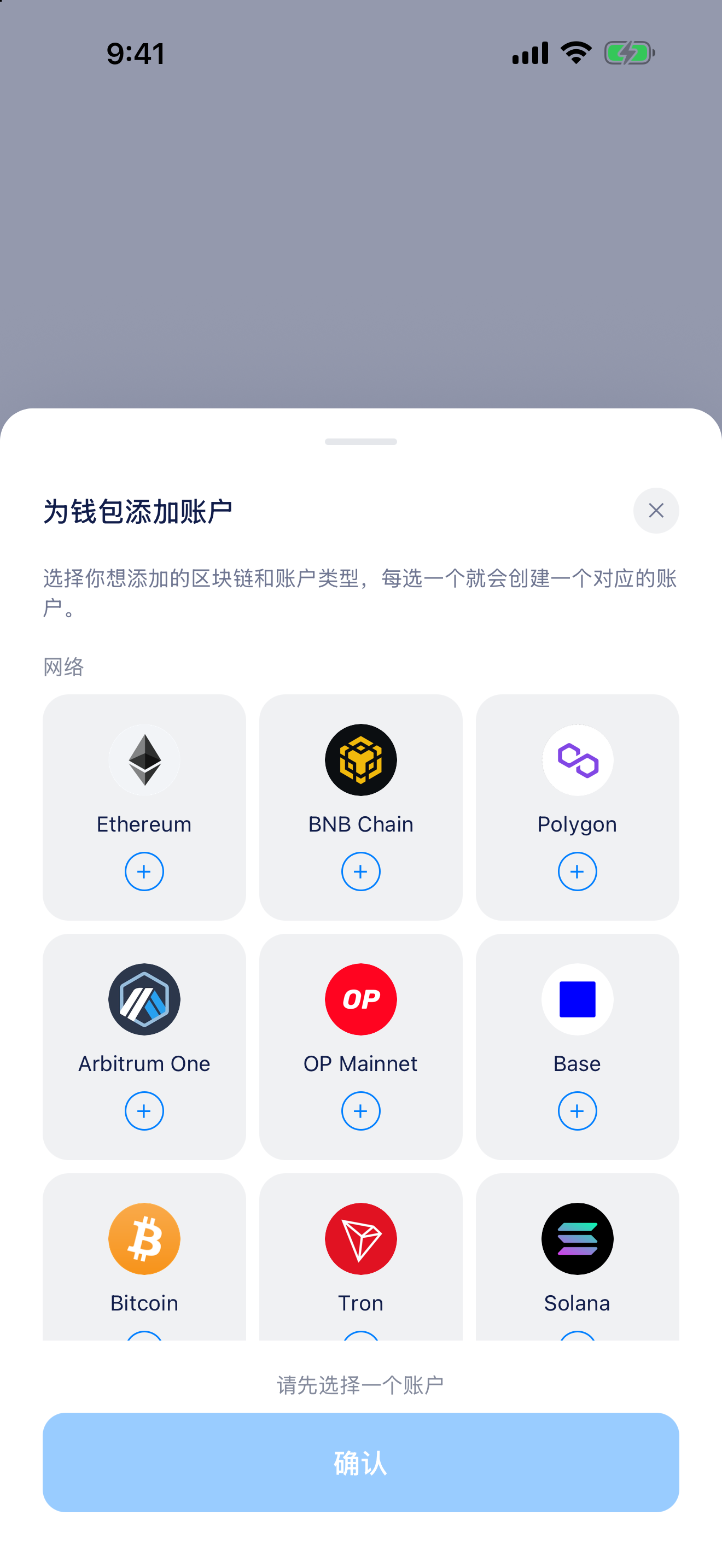
Choose the network when creating an account. Its addresses and assets stay associated with that chain.
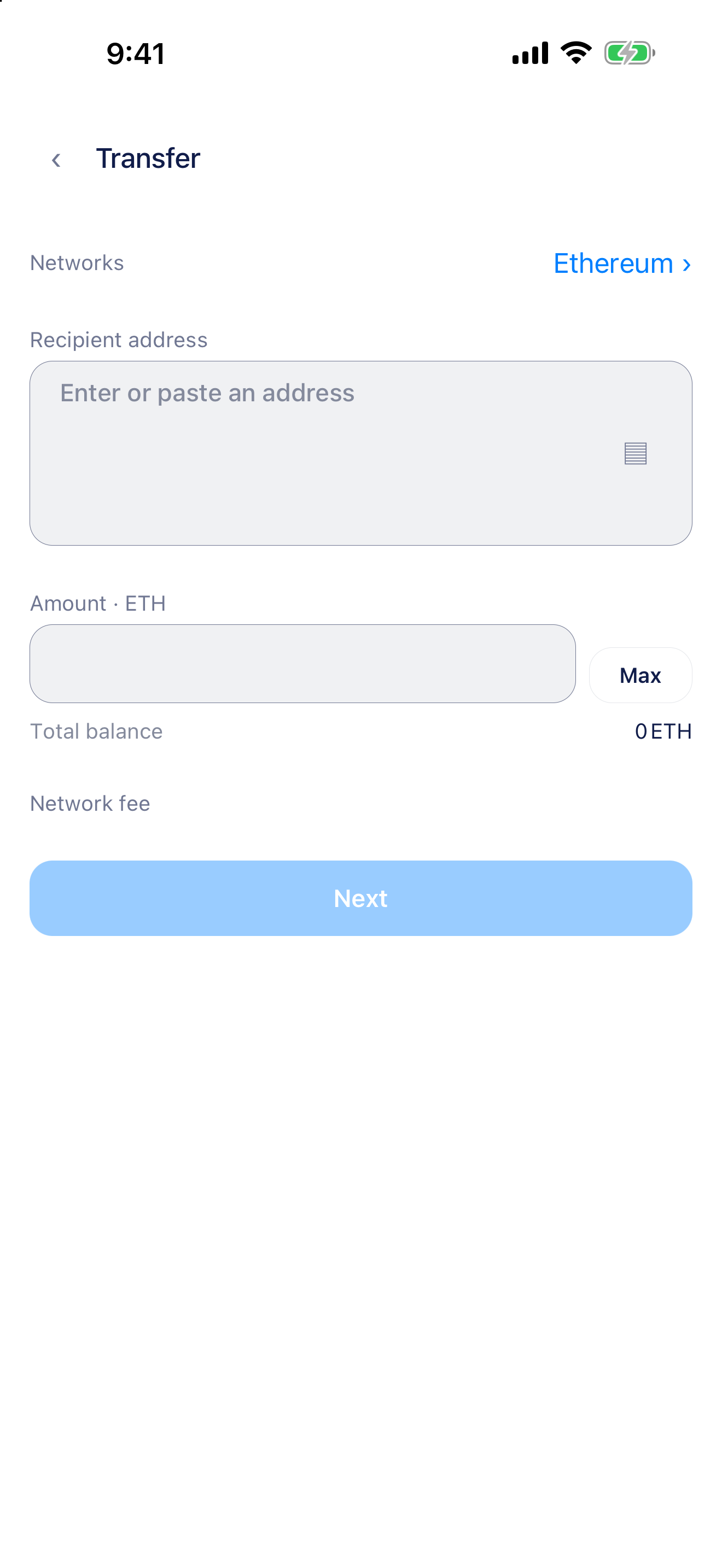
Review the network, recipient, amount and fee before confirming a transfer.
Product UI archive. The captures show interface design, not a live account or transaction.
A multi-chain wallet is most vulnerable where different networks look identical. Address formats, asset precision, native fees and signing semantics vary, and one ambiguous confirmation can cause an irreversible loss.
Users can view and send assets from one place while seeing the selected chain, recipient, total fee and signing counterparty before approval. A chain failure stays local, and an incomplete portfolio total remains unknown.
Address formats, asset precision, native currencies and fee rules differ. One generic validator can select the wrong chain, overspend or underestimate cost.
I use chain-specific adapters to check address compatibility, amount precision and fees. The confirmation shows the amount, fee and total before signing and broadcast.
When one chain times out or an asset has no price, keeping the old total invites the user to trust an incomplete number.
I surfaced errors per chain. When the portfolio total cannot be computed completely, it becomes unknown, and missing prices remain missing.
Navigation can change the page origin, and an interface can hide signing parameters. The user may approve without understanding the counterparty or intent.
I recheck connection eligibility when the page origin changes and show the origin and request parameters on the approval screen. For transfers, the private key is opened for signing only after re-authentication.
For wallets and other tools with irreversible actions, I can help make the network, amount, cost and authorization target clear before the user confirms.
Stablecoin freeze monitoring
Missing data must not become a clean bill of health.
Checks freeze signals against an institution’s address book, along with data coverage and freshness. Results distinguish frozen, no freeze observed and insufficient data, with evidence for each verdict.
When a source fails, coverage expires or a signal cannot be interpreted, an empty result is easily presented as ‘safe’. Any release decision built on that silence lacks a factual basis.
Operators can distinguish a detected freeze from an address that cannot yet be assessed, inspect the reason and check the data timestamp. This supports follow-up checks and review before crediting a deposit.
An address with no freeze record may simply fall outside the covered time, source or signal class. An empty result alone cannot support clearance.
I require trusted coverage and successful reads from registered sources before returning “no freeze observed”. Errors, gaps, stale coverage and uninterpretable signals cannot support that verdict.
A red dot does not let an operator verify the address match, identify the authority behind the event or judge whether the verdict is still current.
I bound each verdict to the institution’s address book, signal identity, coverage time and evidence reference. The interface shows status text and reasons rather than relying on colour alone.
Mapping a risk result directly to automatic acceptance or rejection lets one data layer bypass limits, customer context and compliance process.
I separate freeze detection from business handling. The risk layer supplies a verdict and evidence; integration rules require an uncertain result to stop automatic clearance for human review.
For teams handling stablecoin deposits, this experience applies to source checks, uncertain outcomes and human review before crediting funds.
Personal AI workflow
Capture a thought. Choose three priorities for today.
Quick notes are saved locally before syncing to a private memo store. A local model fills open slots in the daily list and uses the original notes for journals and weekly reviews.
When working across several projects, capturing a thought should not start with a form. Notes need to survive a network interruption, and AI assistance must preserve tasks the user wrote.
Capture first and organize later. User-written tasks and progress notes stay intact; the model suggests additions only when the list has room. Reviews remain traceable to the original notes.
If the shortcut closes before a service or network failure is known, the smallest thought becomes the easiest thing to lose.
I wrote the original text to a hidden temporary file and atomically renamed it into a local queue. Upload runs later; only confirmed success archives the source, while failures remain available for retry.
If a model removes a user task, rewrites the sentence or replaces a progress note, the list may look cleaner while the original commitment becomes unclear.
I protected user-authored text and notes in code. An item can leave the board only when the memo trail shows completion, delay, delegation or pause. Model suggestions fill open slots and remain visually secondary.
If journal, tag or weekly review generation fails mid-write, partial files or broad cleanup can damage source notes that matter more than the summary.
I replaced derived files atomically only when content was complete and changed. Cleanup is limited to artefacts carrying the system’s own marker. Date and tag indexes still render when the model fails.
If you want local AI to organize personal work, I can help design quick capture and automated reviews that preserve original notes and allow human edits.
I have led engineering and cross-functional teams. I work through scope, dependencies and acceptance with the team so that critical implementation questions are addressed while the product is being defined.
Start with a recurring task. Identify its inputs and who bears the cost of an error, then decide whether a model fits. Define what the first experiment must prove and when to stop.
Deliverables: use case, product scope and validation plan
Build around a complete task, including context, tool calls and human review. Work through interrupted jobs and how users correct an output they cannot use.
Deliverables: interaction flow, core implementation and acceptance checks
Map the relationship between ledgers, orders, signatures and external confirmations. Test duplicate requests, timeouts and permission revocation with the team. Prepare a rollback procedure before release.
Deliverables: system design, risk checks and release plan
Describe who uses it, how the task works today and what needs to change. If you have a prototype or a brief, include it.